Buy now, view them for the very first time later.
Because: I have neither the inclination, nor the time, nor the money for a legal dispute over copyright.
All 40 paintings are in a sealed box and may only be viewed and displayed after 70 years have elapsed, in 2095. On may call it "Time capsule" as well.
The title “Greetings from the Old World” draws inspiration from Jaider Esbell’s work “Carta ao Velho Mundo | Lettre au vieux monde”, which I saw earlier this year at the Musée du quai Branly – Jacques Chirac in Paris.
Very close to the source of her artistic creation are the animal motifs of the Brazilian artist Solange Pessoa herself, which I discovered in the current exhibition at the Fondation Cartier on Rue de Rivoli in Paris.
In my series of 40 pieces, every animal tells its own story. Furthermore, they have been given their own habitat: mostly a landscape bathed in the diffuse light of dawn or dusk. Each work has also been given its own title – for these, I have either drawn on everyday French language or selected typical Brazilian first names, which are also frequently used for pets there.
All paintings measure 30 x 40 cm and are painted in acrylic on canvas. They are all listed in the RWV catalogue raisonné under number 658, from 01 to 40.
The titles of the works 658-01 to 658-40 are, in order:
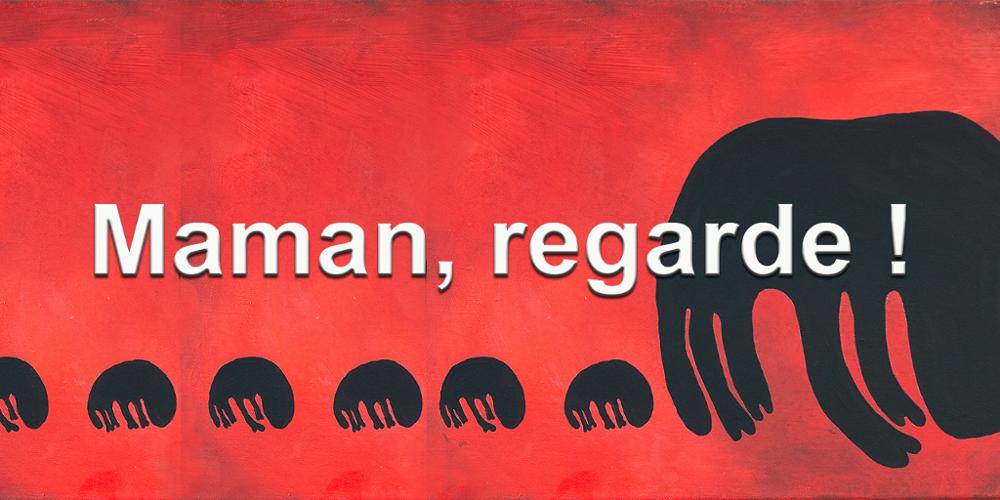
Zeus, Totó, Nina, Maman, attends !, Maman, attends !, Maman, attends ! Bela e Belinha, Cachorrinhos, Tio Fred, Maman, attends !, Papá, Maman, viens !
, Maman ? Apolo, Lola, Mel, Wagner, Thor, Luna, Maman, regarde !, Maman, regarde !, Theo, Cristal, Maman, regarde !, Toby, Plan direct ?, Cacau, Maman, attends !, Léo, Joachim, On y go !, Ah quais ?, Beijinho, Neto, Beijinho, Simba, Gustavo, Maman, viens !, Maman, viens !, Maman, viens !
As questions regarding copyright and plagiarism may arise particularly clearly in relation to this series, which falls under the category of ‘Appropriation Art’, here is a brief, AI-generated explanation referencing ‘Kunstforum International’, which, in my opinion, explains it quite clearly:
Appropriation art refers to the practice of reusing existing images or objects by placing them in a new context. This is often permitted under artistic freedom, quotation rights (§ 51 UrhG), or the so-called pastiche provision (§ 51a UrhG), provided that a new and independent work is created.
The boundary between appropriation and plagiarism is, however, fluid. What matters is whether a significant conceptual transformation has taken place.
Generally considered legally unproblematic:
– Transformation: The source material is altered to such an extent that a new work with its own meaning emerges (e.g. through collage or overpainting).
Problematic or not permitted, by contrast:
– 1:1 copies without any independent creative contribution
– commercial exploitation without substantive engagement with the original work
In Germany, quotation rights are often invoked in this context. A key requirement is a recognisable conceptual connection—the use must not be merely decorative. The pastiche provision (§ 51a UrhG) further protects works that draw on others while developing an independent character.
By comparison, US case law is in part more permissive due to the principle of “fair use”.
This series was created alongside two other groups of works:
Réveillon sur Paris
and
Tierpark Berlin
curated by Stephan Reichmann (info@stephanreichmann.com), Paris (Frankreich)
If you do not want to dig around:
Here sometimes Stephan put together a small collection of his paintings for your convenience. Either new works he wants to show or issues that have touched him just intensively.
Enjoy.